

You can fall for a cushion, a throw and a rug in three different shops and still end up with a sitting room that feels like three rooms arguing. The colours are rarely the real problem. What goes wrong is that nothing in the mix agrees on scale, texture or who is in charge. Settle those three things and you can be far bolder with colour than you think.
Start With One Anchor Textile
Before you buy anything new, decide which piece the others will answer to. In most rooms that is the rug, because it covers the most floor and sets the temperature of everything above it. If your rug is fixed, the sofa takes the role. If both are staying, the largest cushion or your main throw becomes the anchor.
Say the rug is an oatmeal wool flatweave. That one choice already tells you the room wants warm neutrals with texture doing the talking, and that a strong pattern will read as an accent rather than a foundation. Every textile you add now has a simple test to pass: does it belong on that rug? If you have to talk yourself into it, it probably doesn't.
Build a Palette of Three, Not Ten
Colour clashing almost always comes from too many colours of equal weight, not from the colours themselves. Give each one a job and the argument stops.
- Dominant (roughly two thirds): the quiet base. Your rug, a large throw, the plainest cushions. Oatmeal, soft grey, washed charcoal, warm stone.
- Supporting (roughly a third): one mid-tone that has something in common with the dominant. Olive, rust, dusty blue, clay.
- Accent (a small amount): one stronger colour used only on a cushion, a trim, a single stripe. Indigo, mustard, deep green.
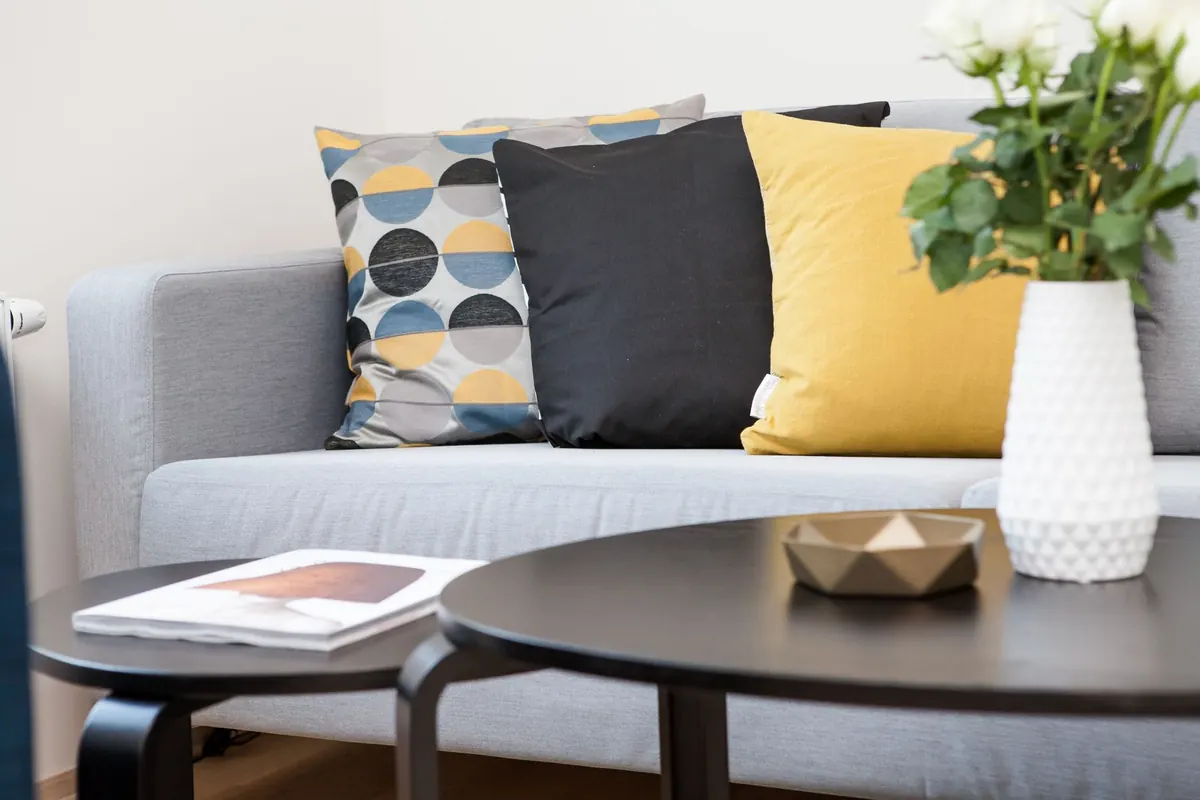
Three colours, many tones. A putty rug, an olive throw, oatmeal linen cushions and one rust striped cushion is a complete scheme. So is a charcoal rug, a cream throw, grey cushions and a single ochre cushion. Notice that in both examples the accent never appears twice at the same size.
Use Scale Deliberately
Most "clashing" textiles are actually fighting over size. Three small prints on one sofa shimmer and buzz, even when the colours are perfect together. Patterns need a hierarchy, just like colour.
Work to three sizes and no more:
- Large: the rug pattern, or a big soft geometric on a 55cm cushion.
- Medium: a classic stripe, check or leaf motif on a 45cm cushion, or the weave structure of a textured throw.
- Small: a neat repeating motif or a trim on a 30cm cushion.
A patterned rug with patterned cushions works beautifully when the two patterns sit at different scales and share at least one colour. It fails when they sit at the same scale, because your eye cannot decide which one to read first.
The squint test
Stand back and half-close your eyes. If the textiles blur into one pleasant, slightly hazy field, the scale is working. If you see spots jumping out at random, one pattern is too close in size to its neighbour. Swap it for a plain cushion or a much larger print.
Let Texture Carry the Weight
When the palette is quiet, texture is what keeps a room from looking flat. Aim for at least three clearly different surfaces in one seating area, and keep just one of them reflective.
Useful contrasts: chunky wool against washed linen, boucle against cotton slub, velvet against jute, ribbed knit against a smooth flatweave. A shiny velvet cushion beside a matte linen one reads as intentional. Two shiny cushions beside each other read as a mistake.
If you can describe the palette in three words and name three textures, the room will hold together.
Give Each Textile a Job
The rug grounds the whole scheme. It should be the calmest large surface in the room. If you want one loud pattern, this is the safest place for it, provided everything above stays quiet.
Cushions do the talking. Odd numbers generally look better than even, and mixing sizes stops a sofa looking like a showroom display. As a rough guide, two larger cushions at each end, one or two smaller ones in front, and vary the fabrics rather than buying a matched set.
Throws add the colour you were nervous about. Because a throw folds and drapes, a stronger colour there feels softer than the same colour on a rigid surface. Drape it over an arm or the back of a chair rather than spreading it flat across the whole sofa.
Keep patterned textiles apart
Two patterns can live in one room, but give them distance. If the rug is busy, keep the cushions plain and let the throw carry a subtle weave. If the cushions are patterned, choose a plain rug and a plain throw so the eye has somewhere to rest.
The Five-Minute Check Before You Buy
- Take a photograph of your rug, sofa and existing cushions in daylight and keep it on your phone. Shop against that, not against your memory.
- Before buying online, check whether the shop accepts returns on textiles. It changes how brave you can be.
- When a new piece arrives, lay it on the rug next to the cushions and look at it in daylight and again in the evening with the lamps on. Colours shift.
- Squint. Then take a photo. Screens flatten texture, but they are honest about whether colours sit comfortably together.
- If one item is the only thing you notice in the photograph, it is either your accent or it is the wrong piece. Decide which.
Buy slowly and in this order: rug first, throw second, cushions last. Cushions are cheap to change and easy to store, so they are the right place to be adventurous. Get the large surfaces right and the small ones can be swapped with the seasons, a new cushion cover, or nothing at all.
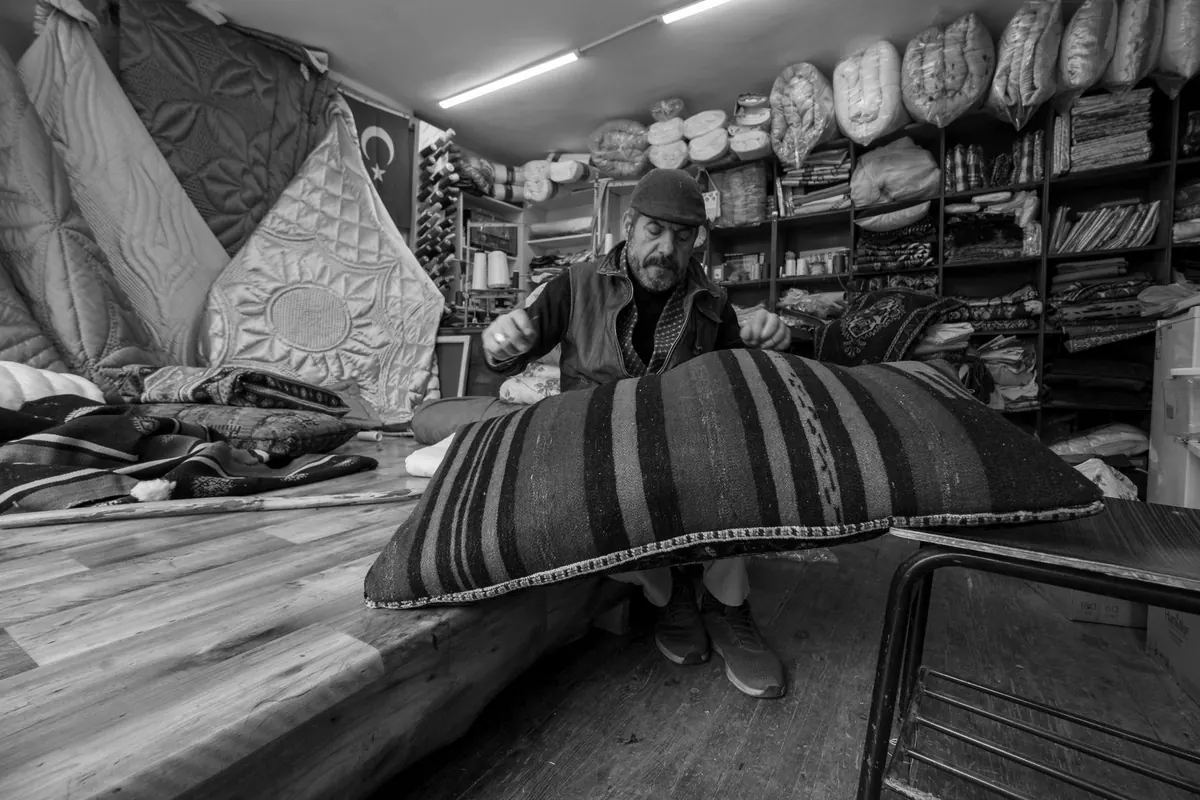
Photo: Murat Marangoz / Pexels
Related posts
More stories you’ll love reading