



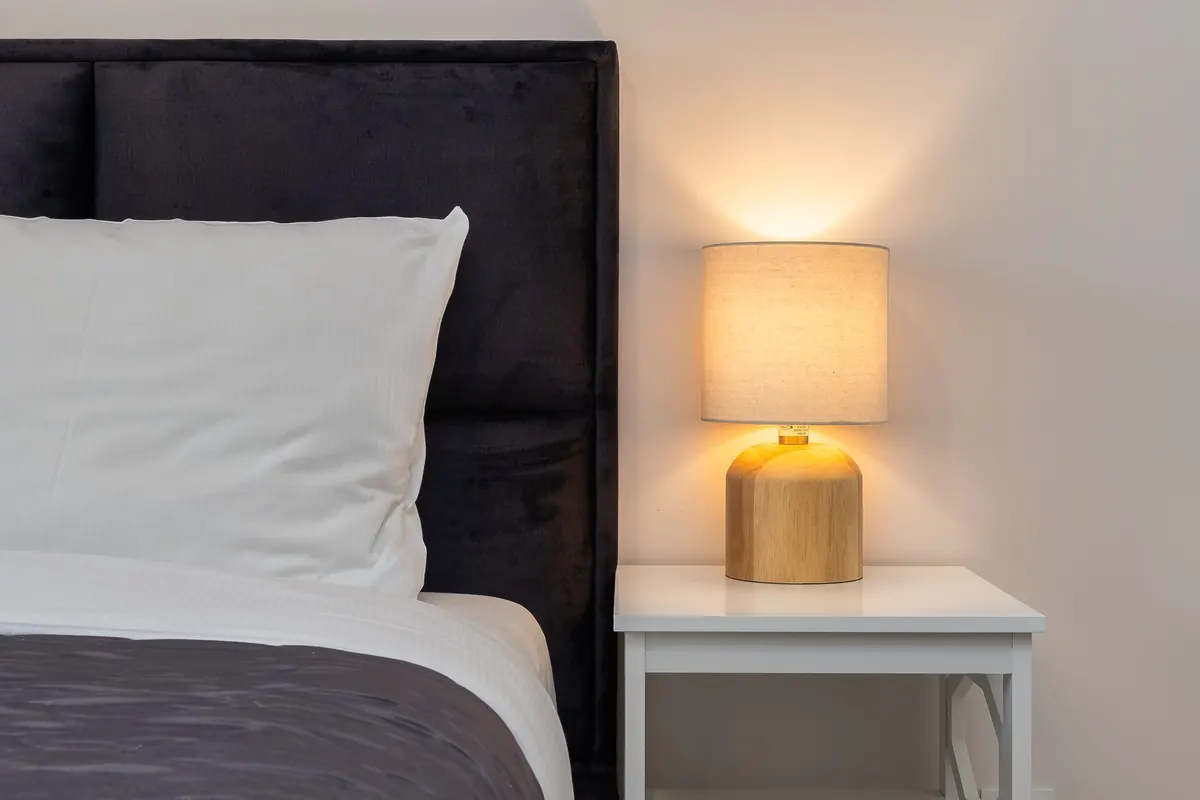
Most bedrooms are lit for the room rather than for the people in it. One bright fixture in the middle of the ceiling, a lamp on one side of the bed, a switch by the door. It works, in the sense that you can see. But good bedroom lighting is about what you are doing at eight in the evening, and again at six in the morning, and how the room feels in between. These are the mistakes that come up again and again, along with fixes that do not require touching your wiring.
The Ceiling Light Is Doing All the Work
A single bare fixture overhead casts hard shadows, flattens faces and turns the bed into a stage. The mistake is rarely the fixture itself; it is expecting one light to handle everything from folding laundry to reading to falling asleep.
Start by softening what is already there. If your ceiling light takes a bare bulb, a wide shade in linen, opal glass or paper will diffuse the glare and drop the brightness at eye level without changing the fitting. If you have recessed downlights, check which ones sit over or near the bed. Those are the ones that shine directly into your eyes when you are propped up on pillows, and they are the ones to put on a separate switch, or replace with a wider-beam, lower-output option.
If you rent
You can still layer light without a screwdriver. Add two plug-in lamps on either side of the bed, run them off one smart plug, and treat the ceiling fixture as a utility light for cleaning and finding lost earrings. Unplugged-in lighting does most of the work in a bedroom anyway.
Bedside Lamps in the Wrong Place
A bedside lamp should serve one seated person reading or scrolling before sleep. Judged against that, plenty of setups fail. The lamp is too low, so the shade cuts across the page. The switch is behind the lamp, or worse, on the cord under the nightstand. There is one lamp between two people, which means one of you is reading in the dark.
As a rule of thumb, the bottom of the shade should land around eye level when you are sitting up in bed, so the light falls on your book rather than into your face. You should be able to turn the lamp off without sitting up or reaching behind furniture. That usually means a wall-mounted swing-arm light, a lamp with a touch or inline switch near your hand, or a smart plug paired with a phone or a small remote.
- Check the shade. An opaque or metal shade pushes light down onto the page; a fully translucent shade scatters it across the room and into your partner's eyes.
- Check the reach. Lie down, then try to switch the lamp off. If you have to stretch, it is in the wrong spot.
- Check the pair. Two people, two light sources, even if one is a small clip-on or wall light rather than a full lamp.
No Dimmer Anywhere
Bedrooms need a range of brightness, not one setting. Full brightness is for tidying up. Ten percent is for talking in bed with the lights low. Nothing handles that jump well except a dimmer.
You have three practical routes. A wall dimmer switch, if the wiring and the light fitting allow it. Dimmable smart bulbs, which let you set levels from a phone or a remote and can be scheduled to fade in the morning. Or a three-way bulb in a lamp socket rated for it, which gives you low, medium and high on the twist of a switch.
One caution: not all LED bulbs dim smoothly. Look for the word dimmable on the packaging, and if a bulb flickers or buzzes when you turn it down, swap the bulb before you blame the dimmer. Cheap LEDs are the usual culprit.
Missing the Reading Light You Actually Need
Sitting up with a book under a ceiling light means squinting or holding the page at an angle to dodge the glare. What you want is a small, bright pool of light aimed at the page from over your shoulder, with the source itself out of sight.
A swing-arm wall light or a floor lamp with an adjustable head does this well. Position it so the light travels past you onto the page, not through the space where your partner is trying to sleep. If you read on a tablet or phone, a dim, warm lamp behind you is easier on the eyes than a screen glowing in a dark room.
Bulbs That Do Not Match
Mismatched colour temperature is the quiet mistake. A cool white bulb left over from the bathroom in one lamp and a warm one in the other makes a well-decorated room look accidental. Stick to warm white, roughly 2700K to 3000K, for every bulb in the bedroom, and buy them in one box so the batch matches.
Consistency does more for a bedroom than any single expensive fixture. Same colour temperature, same brightness, everywhere.
Also worth checking: a bulb with a high colour rendering score will make timber, linen and upholstery look like they do in daylight rather than grey and flat. It is a small detail you notice immediately once you get it right.
The Middle of the Night
The last mistake happens at 3am. You get up, hit a switch, and the whole room floods with light. Your eyes hurt, your partner wakes up, and getting back to sleep takes longer than it should.
Fix it with a low, warm light placed below knee height along the route to the bathroom or door. A plug-in motion-sensor night light does the job and costs very little. Keep phones and bright screens out of arm's reach so you are not tempted to check them, and if you regularly get up in the night, a small rechargeable lamp with a memory dimmer beats any overhead fixture.
Fixing It in an Afternoon
Work through this in order and you can change how the room feels before dinner.
- Write down what you actually do in the bedroom: read, talk, dress, feed a baby, work on a laptop. Each one needs its own light.
- Replace every bulb with the same warm white, dimmable type. Note the colour temperature so you can buy the same again.
- Move or raise the bedside lamps until the shades sit near eye level and the switches are within reach from pillows.
- Add a dimmer, smart bulb or smart plug so you can drop the level in the evening.
- Tame the ceiling light with a diffusing shade, or take the downlights above the bed off the main switch.
- Add one low, warm night light on the path you walk in the dark.
None of this requires a lighting designer or a big budget. It requires deciding what each light is for, then letting it do only that. Get the layers right and the room will feel calmer, and you will notice it most in the last hour before sleep.
Photo: Mateusz Pielech / Pexels
Related posts
More stories you’ll love reading